资料
-
官方教程:https://learnsystemc.com/
- 上面learnsystemc的翻译和整理:https://zhuanlan.zhihu.com/c_1607417635079127040
-
台湾大学systemc slide:http://media.ee.ntu.edu.tw/courses/msoc/slide/02_SystemC_Tutorial.pdf
systemc
最基本的概念:
Below lists the most common terms used for SystemC.
| Method | A C++ method, i.e. a member function of a class. |
| Module | A structural entity, which can contain processes, ports, channels, and other modules. Modules allow expressing structural hierarchy. Module is the principle structural building block of SystemC, used to repsent a component in real systems. |
| Process | A special kind of member function of a sc_module class, registered to the SystemC simulation kernel and called only by the simulation Kernel. |
| Interface | An interface provides a set of method declarations, but provides no method implementations and no data fields. |
| Channel | A channel implements one or more interfaces, and serves as a container for communication functionality. |
| Port | A port is an object through which a module can access a channel’s interface. But modules can also access a channel’s interface directly. |
| Event | A process can suspend on, or be sensitive to, one or more events. Events allow for resuming and activating processes. |
| Sensitivity | The sensitivity of a process defines when this process will be resumed or activated. A process can be sensitive to a set of events. Whenever one of the corresponding events is triggered, the process is resumed or activated. |
sc执行的各种阶段示意
头文件:
需要引入SystemC头文件,一般有两种方法
- 第一种如下
此法会将systenc的所有命名空间,如sc_core等加入当前文件,这种方法用于同老版本的SystemC兼容使用,在未来的版本中可能去掉
- 第二种为
这种声明方式,本质上是第一种方法去掉命名空间,因此使用此法需要自行引入需要的命名空间,通常使用第二种方法,同时配合using
入口地址是sc_main而不是main
sc模块定义
定义一个systemc module有三种方法:简单来说就是定义一个继承自sc_module的class或者struct
-
SC_MODULE(module_name) {}: this uses the systemC defined macro "SC_MODULE", which is equivement to #2. 一般使用这种
-
struct module_name: public sc_module {}: a struct that inherits sc_module.
-
class module_name : public sc_module { public: }: a class that inherits sc_module.
Note, class is identical to struct except for its default access control mode of "private", as compared to "public" of struct.
sc模块的构造函数
-
每个module都需要一个不同的name,其构造函数至少需要一个参数(name)
-
SC_CTOR是一个构造函数的宏,只需要一个参数,就是name
-
如果需要额外传递参数则不能使用这个宏,需要自己写构造函数,建议需要额外参数时使用SC_HAS_PROCESS宏
SC_MODULE(MODULE_C) { // constructor taking more arguments const int i; SC_CTOR(MODULE_C); // SC_HAS_PROCESS is recommended, see next example for details MODULE_C(sc_module_name name, int i) : sc_module(name), i(i) { // explcit constructor SC_METHOD(func_c); } void func_c() { std::cout << name() << ", i = " << i << std::endl; } };
method代表这个模块的成员函数
SC_HAS_PROCESS(module):
- 不会默认创建一个构建函数,需要手动创建
什么是method,什么是process
Simulation process:
-
是sc_module的成员函数
-
没有输入,没有返回值
thread:模拟硬件process
-
并行跑
-
有敏感列表
-
不需要user来调用,始终激活
systemc支持3种threads
-
SC_METHOD():只执行一个周期
-
串行执行
-
类似 verilog的
@always bllock -
用于组合逻辑或者简单的时序逻辑
-
-
SC_THREAD()
-
类似verilog的
@inital block -
只在模拟开始时run,然后就暂停;内部可以包含一个循环,固定时间执行一段code
-
一般用于testbench
-
-
SC_CTHREAD():执行一个或多个周期
-
Clock thread,reference a clock edge
-
串行执行
-
最常用的方法
-
敏感列表:
#include <systemc.h>
SC_MODULE( and2 ) {
sc_in<DT> a, b;
sc_out<DT> f;
void func() {
f.write( a.read() & b.read() );
}
SC_CTOR( and2 ) {
SC_METHOD( func );
sensitive << a << b;
}
}
类似verilog中的
如果要表示时钟上升沿可以通过 sensitive << clk.pos();
sc可以通过
sc_uinit<3> x; // unsigned
sc_init<3> x; // signed
// 与port_in和port_out一起使用
sc_in< sc_unit<1> > a,b;
ports:
-
sc_in
; — input port -
sc_out
; — output port -
sc_inout
; — input/output port
如果sc_in<sc_uint<10> >
Fast Port Binding
上面的port绑定不是很直观并且比较慢,从sc2.1开始采用SC_EXPORT来快速绑定端口,可代替SC_PORT
sc_signal:
-
是一个wire,没有指定方向input or output
-
Current Value (**
cur_val****)**:read()方法返回的值,代表当前仿真时间(或当前 Delta Cycle)下的信号状态。 -
New Value (**
new_val****)**:write()方法更新的值,代表下一个 Delta Cycle 将要呈现的状态。
-
-
其数据流由连接的port指定
-
sc_signal >;
两种使用示例
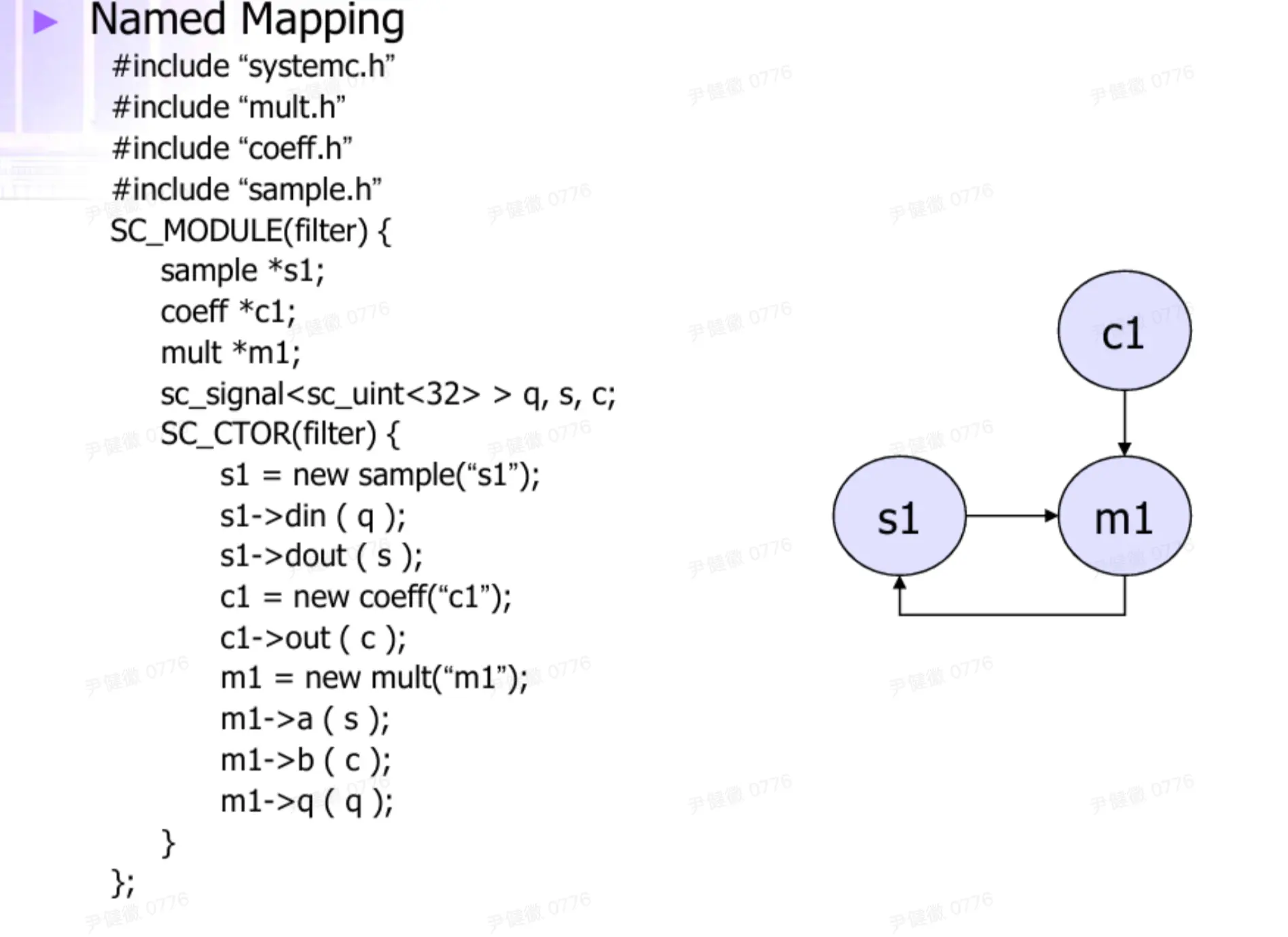
- Name mapping
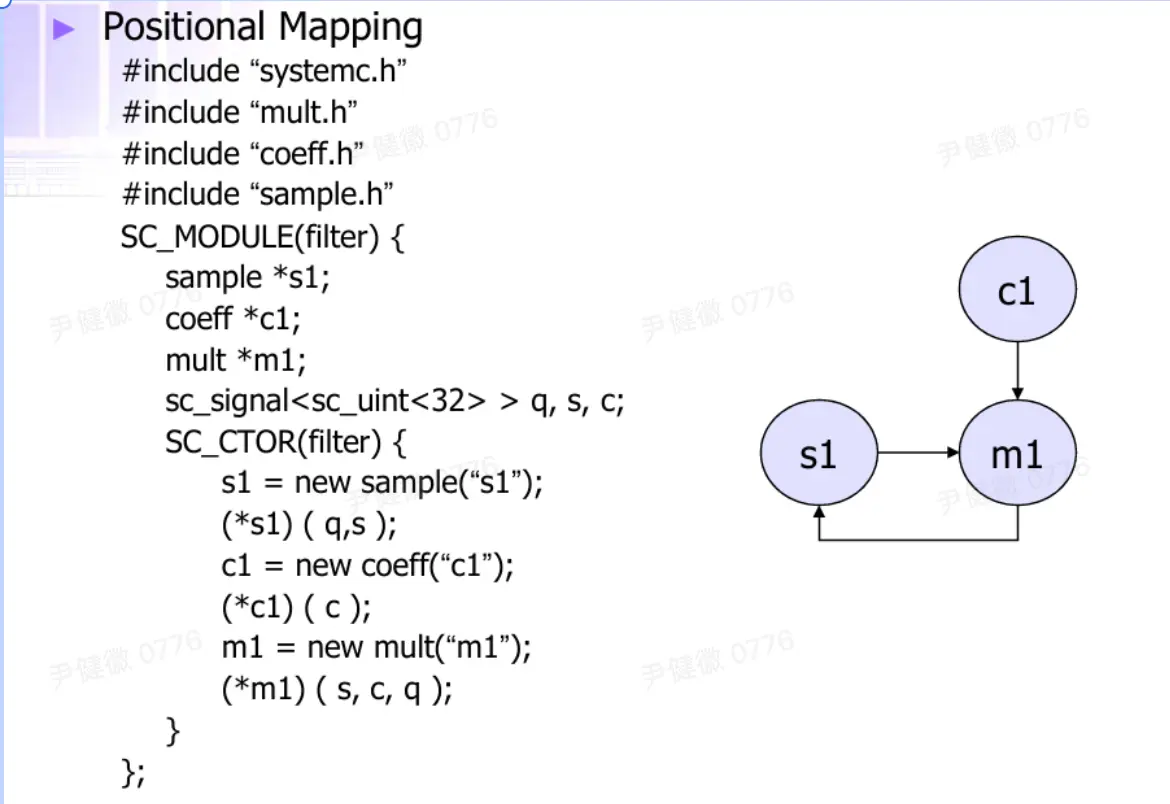
- Positional mapping
SC_CTHREAD:
可以通过reset_signal_is(rst,true)这样来复位
SC_CTHREAD( func, clk.pos());
reset_signal_is(rst,true)
void func(void){
wait();
while(true){
// read inputs
// do something
// write outputs
wait()
}
}
Systemc stage:
-
Elaboration:sc_start之前的准备工作,准备一部分数据结构(modules, ports, primitive channels, and processes),绑定ports
-
Execution
-
Initialization:kernel识别所有待模拟的进程,放置到runable或者waiting set。除了no initialization的进程在waiting里,其余的都在runable。简单来说就是把进程插到调度队列中
-
simulation:调度进程,advance模拟时间
-
evaluate:一次次性run所有的runable process;对于每个process来说,会一直跑直到遇见wait()或者return。如果没有剩余的runable process,evaluate阶段就结束了
-
advance-time:runable process清空时,开始这个阶段。主要完成三件事:使用事件机制将仿真事件转变为closest time;将等待特定时机的processes移动到runnable set;返回evaluate阶段
Execution结束:1.所有process yielded;一个process执行了sc_stop;模拟时间到达设定值
-
-
-
cleanup:销毁对象、memory等
systemc的并发性建模并不是真的并发:实际上是串行执行(串行顺序不清楚如何安排),只是在所有进程执行完之后再增加一个统一的时间,使得外部看上去是并发
Event:event属于sc_event类,用于进程间同步,有如下方法
-
void notify():创建一个即时通知
-
void notify(const sc_time&),void notify(double, sc_time_unit)
-
cancel():删除本event的任意挂起的notify
-
不能删除即时通知
-
任意event只能有最多一个挂起的notify
-
一个event只能有两种动作:wait或者使其发生
waiti:
-
wait():等待敏感列表中的事件
-
wait(e1):等待event e1
-
wait(e1|e2|e3):等待事件e1,e2 or e3
-
wait(e1&e2&e3):等待事件e1,e2 and e3
-
wait(200, SC_NS):等待200ns
-
wait(200, SC_NS, e1):等待200ns之后的event e1
-
wait(200, SC_NS, e1|e2|e3):等待200ns之后的e1,e2 or e3
-
wait(200, SC_NS, e1&e2&e3):等待200ns之后的e1,e2 and e3
-
wait(sc_time(200, SC_NS)):等待200ns
-
wait(sc_time(200, SC_NS), e1):等待200ns之后的event e1
-
wait(sc_time(200, SC_NS), e1|e2|e3):等待200ns之后的e1,e2 or e3
-
wait(sc_time(200, SC_NS), e1&e2&e3):等待200ns之后的e1,e2 and e3
-
wait(200):等待200个时钟周期,仅限于SC_CTHREAD(SystemC 1.0)
-
wait(0, SC_NS):等待一个delta 周期
-
wait(SC_ZERO_TIME):等待一个delta周期
静态wait与动态wait
Delta cycle理解:
https://caslab.ee.ncku.edu.tw/dokuwiki/techdoc:esl:systemc_delta_cycle
在 Verilog 中,你在时钟上升沿(Posedge)写入数据,接收端必须等到**下一个****时钟周期**才能读到数据。
在 SystemC 中,这个“时钟周期”就是 Delta Cycle。
但是delta cycle又不等价于一个时钟周期,它不会推进模拟时间
systemc(二)
datatype
sc_bit只有两个值 0 和 1
sc_logic增加了X和Z值,有4个值
sc_int和sc_uint
- 支持按位操作,支持选择某个bit,支持选择某个范围的bit,支持拼接;和verilog的操作很像
sc_bitint和sc_biguint
sc_bv:二值,额外允许reduction操作,比如and_reduce(),or_reduce(),xor_reduce()
- or_reduce returns the result of ORing all bits in databus,然后返回一个bool值
sc_lv:4值,额外允许reduction操作,与上面的sc_bv类似
各种数据类型的模拟速度:
从上到下依次变慢,原生的c++数据类型最快
还有定点数fixed与浮点数ufixed,暂时不太关注,略过
Basic channels and interfaces
interface是communication暴露出的接口,channel是具体实现communication,可能会包括多个interface,不同的channel对同一种interface的实现可能不一样
interface示例:
-
sc_fifo_in_if
-
sc_fifo_out_if
-
sc_mutex_if
-
sc_semaphore_if
-
sc_signal_in_if
-
sc_signal_inout_if
channel示例:
-
sc_buffer
-
sc_fifo
-
sc_mutex
-
sc_semaphore
-
sc_signal
-
sc_signal_resolved
-
sc_signal_rv
下面介绍基本的channel:sc_mutex,sc_semaphore,sc_fifo,sc_signal,sc_buffer
mutex:独占一个对象,对共享对象做一个保证
- lock(一致阻塞直到获取锁)和trylock(非阻塞,通过返回值判断是否锁)
class bus{
sc_mutex bus_access;
...
void write(int addr, int data){
bus_access.lock();
// perform write
bus_access_unlock();
}
};
sc_semaphore:Have more than one copy of resources,信号量也是锁,但是会有多个可用的资源,只有资源不够用时才会阻塞(PV操作)
sc_fifo:可能是用得最多的建模channel
sc_signal:类似verilog里面的reg
说它是reg是因为其存在这样一种特性,同一计时下先写后读,读出的是旧值,写操作会在当前时间上加一个delta cycle,而读的还是没加delta cycle的值,因此是旧值
Evaluate-update channels
Evaluate stage:从runable的process中选一个出来执行,选谁这个顺序没有规定
计算完成之后可以调用request_update(),可以视作向update阶段发了一个请求,暂时挂起,等到所有process的evaluation结束之后进入update阶段,就会来处理这些挂起的update请求更新值;因此在update完成之前,变量中存的都还是旧值
注意只:The request_update() function may only be called inside member functions of a primitive channel
Update stage:
遍历evaluate阶段所有挂起的update请求,更新值。
在更新值时可能触发某些敏感列表,会唤醒某些进程加入到runable process,此时会+1 delta cycle,回到evaluate阶段继续计算这些process,直到某一时刻,所有值稳定,也没有唤醒新的process,此阶段结束。这里类似组合逻辑的信号传播过程。一级门电路翻转(Update),驱动下一级门电路运算(Evaluation),直到整个电路稳定。
接下来会有两个选择:
-
查看未来的时间轴事件队列(Event Queue)。如果未来没有任何安排(没有
wait(time),也没有next_trigger(time)),说明仿真任务结束,调用sc_stop()。 -
如果还有time event notify:内核将当前仿真时间(\(T_{now}\))更新为事件队列中最近的下一个时刻(\(T_{next}\))。Verilog 类比:比如从 #10 跳到了 #20。
Advance time:仿真时间的推进可能会触发某些process,需要把他们加入
写systemc的多种视角:
-
Direct top-level
-
Indirect top-level
-
Direct sub-module header-only
-
Indirect sub-module header-only
-
Direct sub-module
-
Indirect sub-module
communication
port就是指向channel的一个指针
sc的interface是继承自sc_interface的虚类
sc的channel是实现了一个或者多个interface的类,继承自sc_channel或者sc_prim_channel
互联的多种方式:可以看看选用什么类型的port
Port connection可以by name或者by position,这点类似verilog的模块初始化。说是connection,其实就是指针的赋值
更多有关ports的信息:
-
sc_fifo_out_if (if是interface的缩写)
-
write()
-
nb_write()
-
num_free()
-
data_read_event()
-
-
sc_fifo_in_if
-
read()
-
nb_read()
-
num_available()
-
data_written_event()
-
sc_fifo、sc_fifo_in_if、sc_fifo_in的区别是什么?
-
sc_fifo是一个primitive channel
-
sc_fifo_in_if:是一个interface,由sc_fifo实现
- 等价于 sc_port
- 等价于 sc_port
-
sc_fifo_in:是一个port:A specialized port class for use when reading from a fifo. (sc_port)
interface与port的区别,interface会有一些实现好的函数,而port只是一个指针的包装
sc_port<> Array可以通过如下进行初始化
sc_export:把内部的服务暴露给外面,让外部可以调用;类似一个函数指针;对比sc_port,它像一个**指针**。它定义了“我想调用 IF 接口里的函数(比如 read / write)”,但它自己没有实现这些函数。它必须连接到一个实现了该接口的对象上。例子:https://learnsystemc.com/basic/export
// Learn with Examples, 2020, MIT license
#include <systemc>
using namespace sc_core;
SC_MODULE(MODULE1) { // defines one module
sc_export<sc_signal<int>> p; // an export for other modules to connect
sc_signal<int> s; // a signal (channel) inside the module. If not using export, the channel need to be defined outside module1.
SC_CTOR(MODULE1) {
p(s); // bind an export to an internal channel
SC_THREAD(writer); // a process to write to an internal channel
}
void writer() {
int val = 1; // init value
while (true) {
s.write(val++); // write to an internal channel
wait(1, SC_SEC);
}
}
};
SC_MODULE(MODULE2) { // a module that reads from an export
sc_port<sc_signal_in_if<int>> p; // a port used to read from an export of another module
SC_CTOR(MODULE2) {
SC_THREAD(reader); // a process to read from an outside channel
sensitive << p; // triggered by value change on the channel
dont_initialize();
}
void reader() {
while (true) {
std::cout << sc_time_stamp() << ": reads from outside channel, val=" << p->read() << std::endl; // use port to read from the channel, like a pointer.
wait(); // receives from port
}
}
};
int sc_main(int, char*[]) {
MODULE1 module1("module1"); // instantiate module1
MODULE2 module2("module2"); // instantiate module2
module2.p(module1.p); // connect module2's port to module1's export. No need to declare a channel outside module1 and module2.
sc_start(2, SC_SEC);
return 0;
}